How field research uncovered the hidden side of Galp's loyalty experience
Galp • 2024
UX Research
Guerrilla Testing
Product Design

The app that launched before it was understood
Galp Wallet is the loyalty feature inside Mundo Galp — Galp's customer app. It lets users accumulate wallet balance and unlock coupons at the pump. It launched as an MVP under a tight timeline, with known bugs and without a clear picture of how real users were actually interacting with it in the wild.
The question the team needed to answer: does this experience actually work for the people using it?
What nobody had seen yet
We went to the field. Over a series of visits to Galp petrol stations across Portugal, we conducted contextual tests with real loyalty programme users, watching them fuel up, navigate the app, and try to redeem their balance at the checkout.
We also spoke with gas station operators. That turned out to be the most revealing part of the study.
14 tests conducted (5 contextual, 9 guerrilla, plus conversations with operators).
Entirely field-based — real context, real pressure, real friction.
What users struggled with
The problems weren't subtle. Nearly every participant hit the same walls:
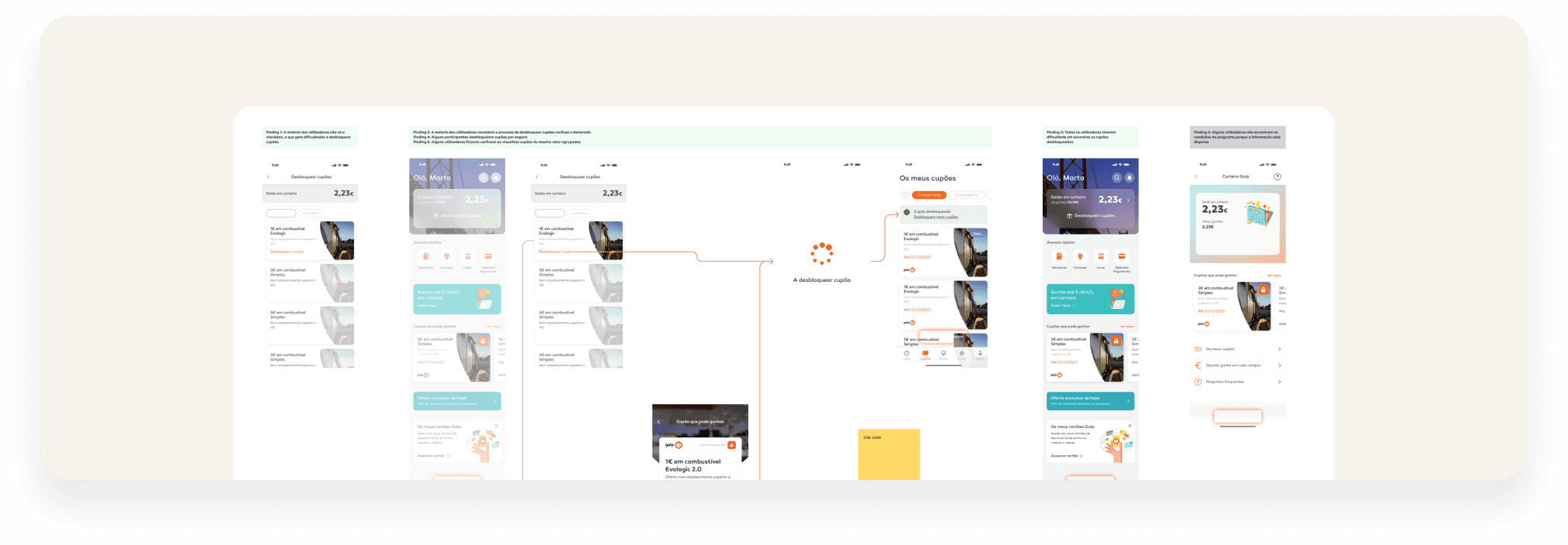
Most users didn't notice the checkbox to unlock coupons, and couldn't complete the flow without help
The process of unlocking coupons was confusing and time-consuming, particularly at the checkout queue
All users had difficulty finding their unlocked coupons after selecting them
Several unlocked coupons by mistake
Programme conditions were scattered and hard to find — users didn't understand the rules
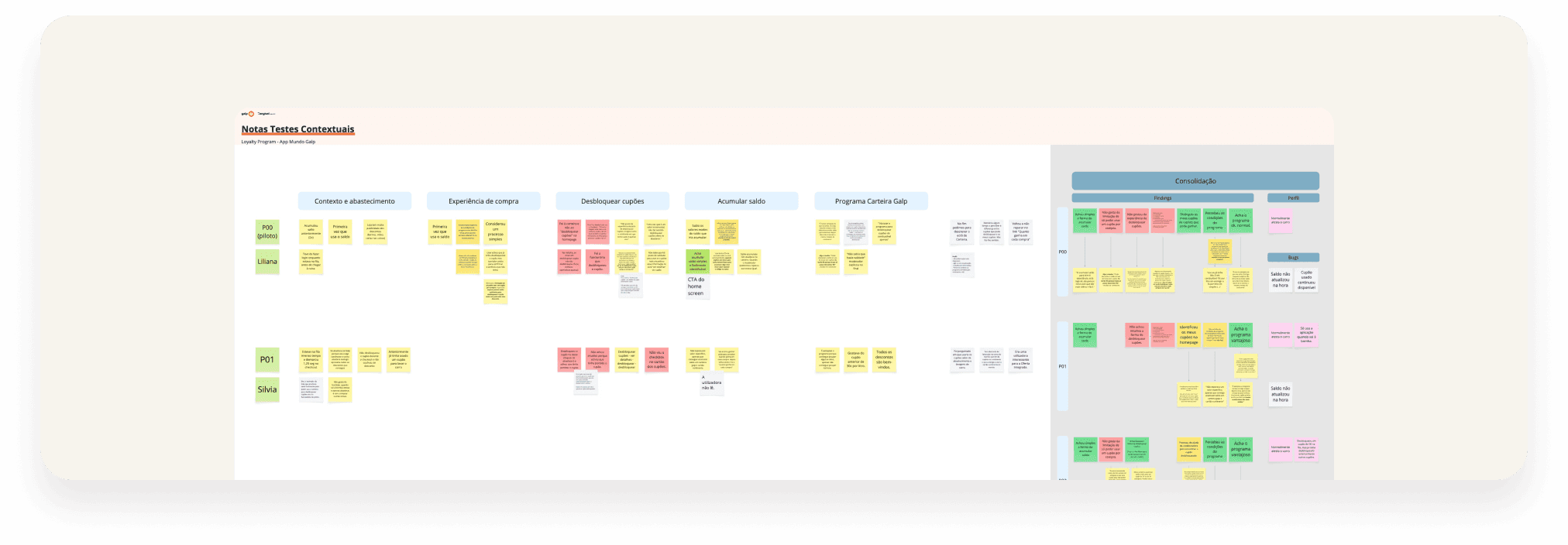
Users expected the Galp Wallet to work like a points card: simple, automatic, instant. The reality was several steps more complex than they anticipated.
The hidden side: the operators
The most unexpected findings came from the people on the other side of the transaction. Operators were dealing with the consequences of every usability failure, in real time, with a queue of customers waiting.
The average checkout interaction involving the Galp Wallet took around 3 minutes, on top of the time already spent in the queue. That's a significant operational cost that wasn't visible in any analytics dashboard.
Beyond the time: operators couldn't guide users through technical issues because they didn't have access to the app themselves. The system allowed discount combinations that shouldn't have been possible. And customers frequently needed operator assistance just to complete a flow that was designed to be self-serve.
The loyalty programme was creating friction not just for users, but for the entire service experience at the pump.
What the research changed
We presented the findings to stakeholders. The insights were new, particularly around the operator experience, which the team hadn't anticipated. Some improvements to copy and microcopy were made as a result.
Not everything was acted on. Some recommendations were set aside due to a planned evolution of the feature that was already in progress. We delivered an additional iteration incorporating stakeholder feedback focused on quick wins within the existing MVP flow.
Shortly after, I moved to the G-Power Design System project. I didn't follow the implementation through.
What I took away
Field research changes what you see. The operator angle only emerged because we were physically present at the pump, watching the full transaction unfold. No remote test would have surfaced that friction.
Presenting findings that challenge assumptions is part of the job. So is adapting when the path forward isn't the one you recommended.